Ökosystemleistungen des Waldes
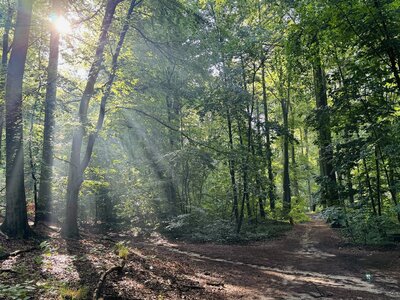
Unter Ökosystemleistungen werden Prozesse, Funktionen und Produkte verstanden, die vom Ökosystem Wald bereitgestellt werden. Beispiele sind im Rahmen der Nutz-, Schutz- und Erholungsfunktion des Waldes: Klimaschutz, Wasserhaushaltsregulierung, Erosionsschutz, Biodiversität, Rohstoffproduktion (u.a. Holz), Reinhaltung der Luft. Eine Gewichtung und/oder Priorisierung einzelner Ökosystemleistungen führt zu Anpassungshandlungen in der Waldbewirtschaftung.
BRUGGER, P., F. de ROO, K. KRÖNIGER, E. ROTENBERG, F. TATARINOV, D. YAKIR, M. ZEEMAN und M. MAUDER (2019): Contrasting turbulent transport regimes explain cooling effect in a semi-arid forest compared to surrounding shrubland. Agricultural and Forest Meteorology 269-270, 19–27.
GANG, B., L. BINGHAM, E. GOSLING und T. KNOKE (2024): Assessing the suitability of under-represented tree species for multifunctional forest management—an example using economic return and biodiversity indicators. Forestry: An International Journal of Forest Research 97, 255–266.
HENDING, D., H. RANDRIANARISON, N. N. M. ANDRIAMAVOSOLOARISOA, C. RANOHATRA-HENDING, M. HOLDERIED, G. MCCABE und S. COTTON (2023): Forest fragmentation and its associated edge-effects reduce tree species diversity, size, and structural diversity in Madagascar’s transitional forests. Biodiversity and Conservation 32, 3329–3353.
KNOKE, T., P. BIBER, T. SCHULA, J. FIBICH und B. GANG (2024): Minimising the Relative Regret of Future Forest Landscape Compositions: The Role of Close-to-Nature Stand Types.
KNOKE, T., E. GOSLING, D. THOM, C. CHREPTUN, A. RAMMIG und R. SEIDL (2021): Economic losses from natural disturbances in Norway spruce forests – A quantification using Monte-Carlo simulations. Ecological Economics 185, 107046.
KNOKE, T., N. HANLEY, R. M. ROMAN-CUESTA, B. GROOM, F. VENMANS und C. PAUL (2023): Trends in tropical forest loss and the social value of emission reductions. Nature Sustainability 6, 1373–1384.
KNOKE, T., M. KINDU, I. JARISCH, E. GOSLING, S. FRIEDRICH, K. BÖDEKER und C. PAUL (2020): How considering multiple criteria, uncertainty scenarios and biological interactions may influence the optimal silvicultural strategy for a mixed forest. Forest Policy and Economics 118, 102239.
KNOKE, T., C. PAUL, E. GOSLING, I. JARISCH, J. MOHR und R. SEIDL (2023): Assessing the Economic Resilience of Different Management Systems to Severe Forest Disturbance. Environmental & resource economics 84, 343–381.
KOTOWSKA, M. M., R. M. LINK, A. RÖLL, D. HERTEL, D. HÖLSCHER, P.-A. WAITE, G. MOSER, A. TJOA, C. LEUSCHNER und B. SCHULDT (2021): Effects of Wood Hydraulic Properties on Water Use and Productivity of Tropical Rainforest Trees. Frontiers in Forests and Global Change 3.
MEESENBURG, H., B. AHRENDS, S. FLECK, M. WAGNER, H. FORTMANN, B. SCHELER, U. KLINCK, I. DAMMANN, J. EICHHORN, M. MINDRUP und K. J. MEIWES (2016): Long-term changes of ecosystem services at Solling, Germany: Recovery from acidification, but increasing nitrogen saturation? Ecological Indicators 65, 103–112.
OBERMEIER, W. A., L. W. LEHNERT, M. J. POHL, S. MAKOWSKI GIANONNI, B. SILVA, R. SEIBERT, H. LASER, G. MOSER, C. MÜLLER, J. LUTERBACHER und J. BENDIX (2019): Grassland ecosystem services in a changing environment: The potential of hyperspectral monitoring. Remote Sensing of Environment 232, 111273.
SCHMIDT, M. (2020): Standortsensitive und kalibrierbare Bonitätsfächer: Wachstumspotenziale wichtiger Baumarten unter Klimawandel. Allgemeine Forst und Jagdzeitung 190, 136–160.
SENF, C. und R. SEIDL (2021): Mapping the forest disturbance regimes of Europe. Nature Sustainability 4, 63–70.
STORCH, F., S. BOCH, M. M. GOSSNER, H. FELDHAAR, C. AMMER, P. SCHALL, A. POLLE, F. KROIHER, J. MÜLLER und J. BAUHUS (2023): Linking structure and species richness to support forest biodiversity monitoring at large scales. Annals of Forest Science 80.
WEI, J., G. von ARX, Z. FAN, A. IBROM, M. MUND, A. KNOHL, R. L. PETERS und F. BABST (2024): Drought alters aboveground biomass production efficiency: Insights from two European beech forests. The Science of the total environment 919, 170726.